Module 4 · Lab 2: serving a real model
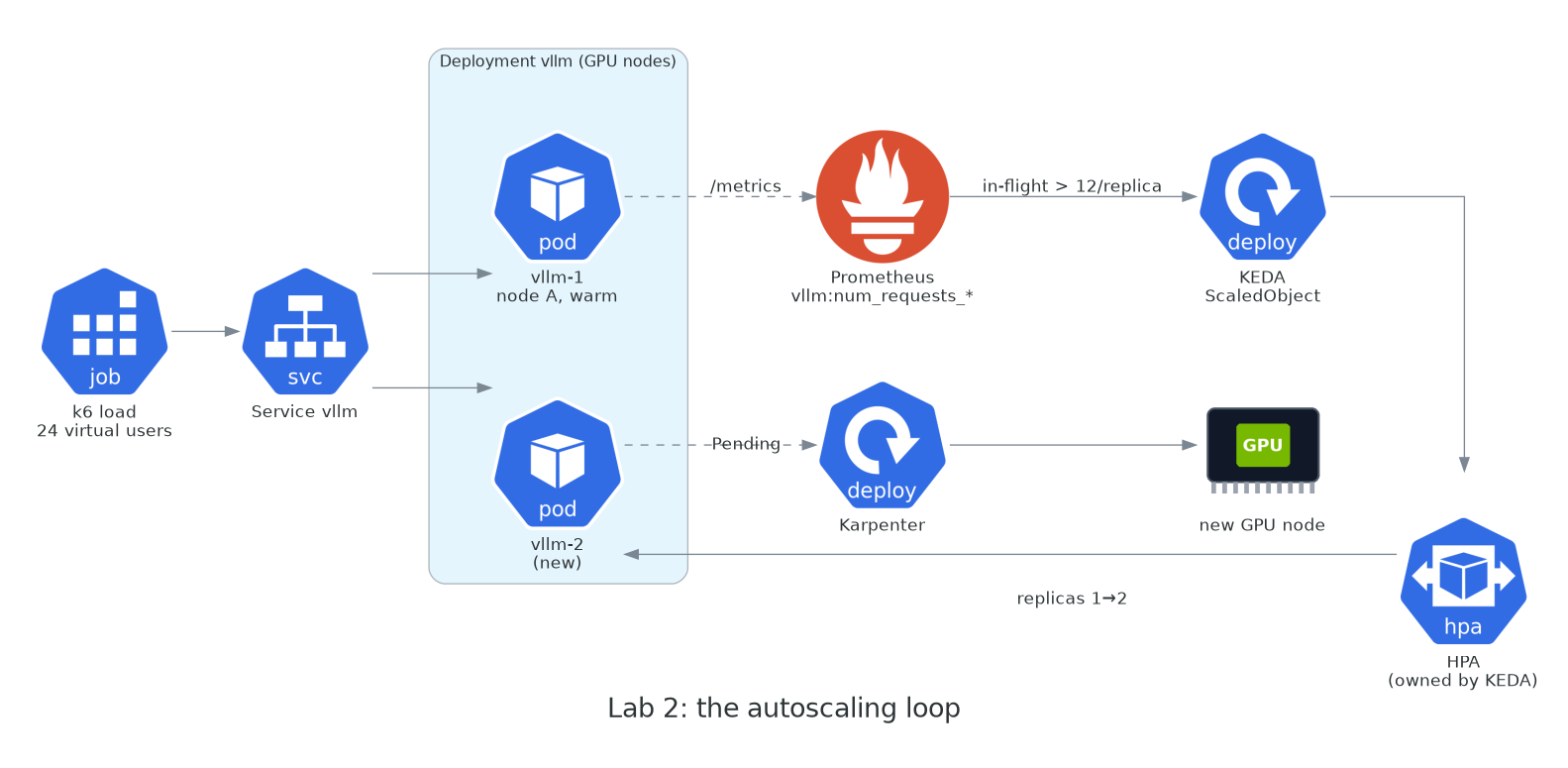
Goal: a real LLM served from your GPU nodes through an OpenAI-compatible API, load-tested, and autoscaling — with Karpenter adding a GPU node behind the autoscaler while you watch.
The model and the server
- vLLM — the de-facto open-source inference server: continuous batching, paged KV cache, an OpenAI-compatible HTTP API, and Prometheus metrics out of the box. One container image, one process per GPU.
Qwen/Qwen2.5-1.5B-Instruct— 1.5 billion parameters, Apache-2.0, not gated (no Hugging Face token, no click-through licence), a single 3 GB safetensors file. Small enough to download in a minute and to leave most of a 24 GB A10G/L4 for KV cache, big enough to give coherent answers. Swap in anything else later; the manifest doesn't care.
Steps
| Step | What you do | Time |
|---|---|---|
| 4.1 Deploy vLLM | Namespace, Deployment, Service, PodMonitor. The pod lands on your warm node. | 3 min |
| 4.2 Walk the manifest | While it starts: probes, shared memory, the weights cache, resources — every line that's there for a GPU reason | 8 min |
| 4.3 Smoke test | curl a chat completion from your own endpoint. Checkpoint 3. |
5 min |
| 4.4 Load test | One minute of k6 against one replica: watch it saturate and queue | 6 min |
| 4.5 Autoscale | KEDA ScaledObject on requests in flight → HPA → replica 2 → Karpenter → node C | 15 min |
| 4.6 Cold start, live | Time every phase of replica 2's start, and see which levers you already pulled | 8 min |
Hard gate
Checkpoint 3 is a completion — real generated text — returned from your endpoint. It comes early in the lab (4.3) on purpose: once you have it, everything after is about making it faster and bigger.