4.6 Cold start, live
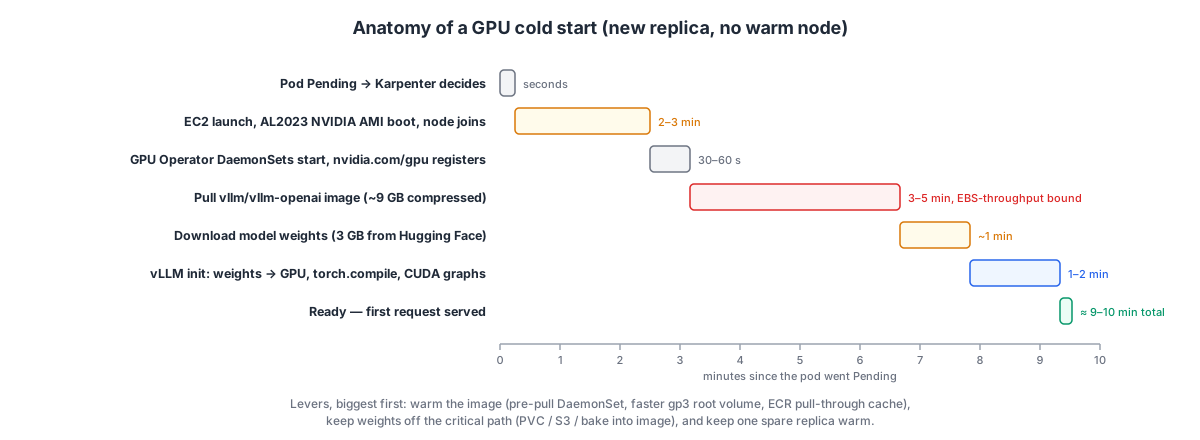
Replica 1 was ready ~4 minutes after kubectl apply. Replica 2 will take ~9. The difference is everything that was warm on node A and cold on node C. Time it while it happens.
Measure it
Pull the timestamps from the pod's events and the node's:
POD2=$(kubectl -n vllm get pods -l app=vllm --sort-by=.metadata.creationTimestamp -o jsonpath='{.items[-1].metadata.name}')
kubectl -n vllm get events --field-selector involvedObject.name=$POD2 --sort-by=.lastTimestamp \
  -o custom-columns='TIME:.lastTimestamp,REASON:.reason,MESSAGE:.message'
TIME                   REASON            MESSAGE
2026-09-17T14:52:31Z   Nominated         Pod should schedule on: nodeclaim/gpu-c3ptx
2026-09-17T14:55:18Z   Scheduled         Successfully assigned vllm/vllm-7b9d6c4f8-zr8hk to ip-10-0-31-9.ec2.internal
2026-09-17T14:55:20Z   Pulling           Pulling image "vllm/vllm-openai:v0.28.0"
2026-09-17T14:59:04Z   Pulled            Successfully pulled image "vllm/vllm-openai:v0.28.0" in 3m44s
2026-09-17T14:59:05Z   Created           Created container vllm
2026-09-17T14:59:05Z   Started           Started container vllm
And from the log, the two remaining phases:
Fill in your own table:
| Phase | Started | Took | Lever |
|---|---|---|---|
| Pending → node nominated | Nominated |
seconds | — |
| Node launch + join + GPU registered | Nominated → Scheduled |
~2.8 min | instance warm pools · keep a spare node |
| Image pull | Pulling → Pulled |
~3.7 min | pre-pull DaemonSet · faster EBS · smaller image · ECR pull-through cache |
| Weights download | Started → 100% |
~1 min | PVC / hostPath cache · S3 Mountpoint · bake into image |
| Engine init | 100% → startup complete |
~1 min | --load-format · compile cache volume · smaller max-model-len |
| Total | ~9 min |
The levers, biggest first
1. Don't pull the image on the critical path. You already have the pre-pull DaemonSet — it landed on node C too, but simultaneously with the vLLM pod, so it didn't help this time. It helps the next pod on that node, and every node that exists before load arrives. Combine it with the blockDeviceMappings throughput you set in Lab 1 (500 MB/s vs. the 125 MB/s gp3 default), an ECR pull-through cache so the 9 GB comes from ECR in-region rather than Docker Hub through your NAT gateway, and a slimmer image if you can build one.
2. Don't download weights on the critical path. Options, in increasing effort: a hostPath cache so replicas on the same node share weights; a ReadWriteMany volume (EFS) or a per-AZ PVC snapshot; Mountpoint for S3 to stream weights from a bucket in-region; or bake the weights into the image (fast, but now every model change is an image build). For a 3 GB model the download is a minute; for a 70B model it's the whole cold start.
3. Keep one replica of headroom. The cheapest way to hide a 9-minute cold start is to never need it at zero notice: minReplicaCount: 2, or a lower threshold so scale-out starts before saturation. That's a cost/latency trade you make with a number, not an architecture.
4. Keep a warm node. A NodePool with consolidateAfter: 30m and a PodDisruptionBudget keeps the last node around between bursts. Karpenter can't launch an EC2 instance faster than EC2 can boot it; the only way to beat ~3 minutes is to not need a new one.
5. Shrink engine init. --max-model-len sizes the KV cache profile; a persistent volume at ~/.cache/vllm keeps the torch.compile artifacts between restarts. Minor next to the first two, but free.
Spot makes cold starts more likely, not just cheaper
A Spot reclaim gives you two minutes' notice, and the replacement node goes through this entire timeline. If your SLO can't absorb a 9-minute capacity dip, either run two replicas on different nodes, keep an On-Demand floor (minReplicaCount pinned to an on-demand NodePool via nodeSelector), or both.
When replica 2 shows 1/1 Ready, go back to 4.5 and finish the load test. Then run the validator: